The Invisible Shield: Exploring Liquid Argon’s Critical Role in High-Purity Welding
When we think of welding, the immediate image is often one of blinding sparks, intense heat, and molten metal. It is a violent process of fusing materials together. However, achieving perfection in this fiery environment requires an element of absolute calm and purity. This is where an invisible shield steps in to protect the integrity of the weld. In industries where flawless seams are not just desired but demanded—such as aerospace, pharmaceuticals, and semiconductor manufacturing—the standard for quality is exceptionally high. At the heart of meeting these stringent requirements is a substance that remains unseen yet indispensable: Liquid Argon.
The journey from a cryogenic liquid to a protective gas is a fascinating one, and its application in High-Purity Welding is a testament to precision engineering. This article delves deep into the science, applications, and critical importance of utilizing this noble gas as a shielding agent, exploring why it has become the gold standard for creating immaculate welds in the modern industrial landscape.
Understanding the Need for Protection
Before exploring the solution, one must first understand the problem. Welding involves melting metals at extremely high temperatures. At these elevated temperatures, metals become highly reactive. The ambient atmosphere, which we breathe effortlessly, is a hostile environment for molten metal.
Oxygen, nitrogen, and water vapor present in the air are eager to interact with the weld pool.
-
Oxygen causes rapid oxidation, leading to porosity, weakened structural integrity, and poor appearance.
-
Nitrogen can dissolve into the molten metal, causing brittleness and decreasing the mechanical properties of the joint.
-
Moisture introduces hydrogen, which can lead to hydrogen-induced cracking, a severe defect that can compromise the entire structure.
-
To prevent these detrimental reactions, the weld area must be isolated from the surrounding atmosphere. This isolation is achieved through the use of a Shielding Gas.
The Evolution of Shielding Gases
Historically, various methods were employed to protect welds, including the use of flux coatings which vaporized to create a temporary shield. While effective for general applications, these methods often left behind slag that required post-weld cleaning and could not guarantee the absolute purity required for advanced applications.
The introduction of inert gases revolutionized the welding industry. By blanketing the weld zone with a gas that does not react with the molten metal, welders could achieve cleaner, stronger, and more aesthetically pleasing results. Among the various gases explored, argon quickly emerged as the frontrunner, particularly for processes like Gas Tungsten Arc Welding (GTAW or TIG) and Gas Metal Arc Welding (GMAW or MIG).
The Noble Champion: Why Argon?
Argon is a noble gas, meaning it is chemically inert under standard conditions. It is colorless, odorless, tasteless, and non-toxic. More importantly, it is abundant—making up approximately 0.93% of the Earth’s atmosphere. This combination of inertness and relative availability makes it an ideal candidate for industrial applications.
But what makes argon specifically suited for high-stakes welding?
-
Absolute Inertness: Argon does not react with the molten weld pool, the tungsten electrode (in TIG welding), or the filler metal. It simply displaces the reactive atmospheric gases, creating a pure environment for fusion to occur.
-
High Density: Argon is approximately 1.38 times heavier than air. This is a crucial physical property. When deployed over a weld, its density allows it to effectively blanket the area, sinking down and pushing lighter, reactive gases away, providing robust and stable coverage.
-
Ionization Potential: Argon has a relatively low ionization potential (15.7 eV). This means it is relatively easy to strike and maintain a stable electric arc in an argon atmosphere. A stable arc is essential for precise control over the heat input and the weld bead profile.
-
Excellent Arc Characteristics: An argon arc is smooth and quiet, offering deep penetration and a highly focused heat zone. This is particularly beneficial for welding thin materials or when working with heat-sensitive alloys.
The Shift to the Cryogenic State: The Advantage of Liquid Supply
While argon gas is the active shielding agent, the method of delivery and storage plays a vital role in industrial efficiency and purity control. For many high-volume or high-purity applications, supplying argon in gaseous cylinders is impractical. This brings us to the significance of the liquid state.
Efficiency in Storage and Transport
Gases take up a significant amount of space. Compressing them into cylinders is standard practice, but even at high pressures, the volume of gas contained is relatively small. The expansion ratio of argon from liquid to gas is a staggering 1 to 840.
This means that one volume of liquid expands to 840 volumes of gas at standard temperature and pressure.
| Supply Method
| State
| Primary Advantage
| Typical Usage Scenario
|
| High-Pressure Cylinder | Gaseous | Portability, low initial cost | Small shops, occasional use, mobile welding |
| Microbulk/Dewar | Liquid | Improved efficiency, fewer changeouts | Medium-sized fabrication shops |
| Bulk Tank | Liquid | Maximum volume, highest purity, lowest unit cost | Large manufacturing plants, automated welding lines |
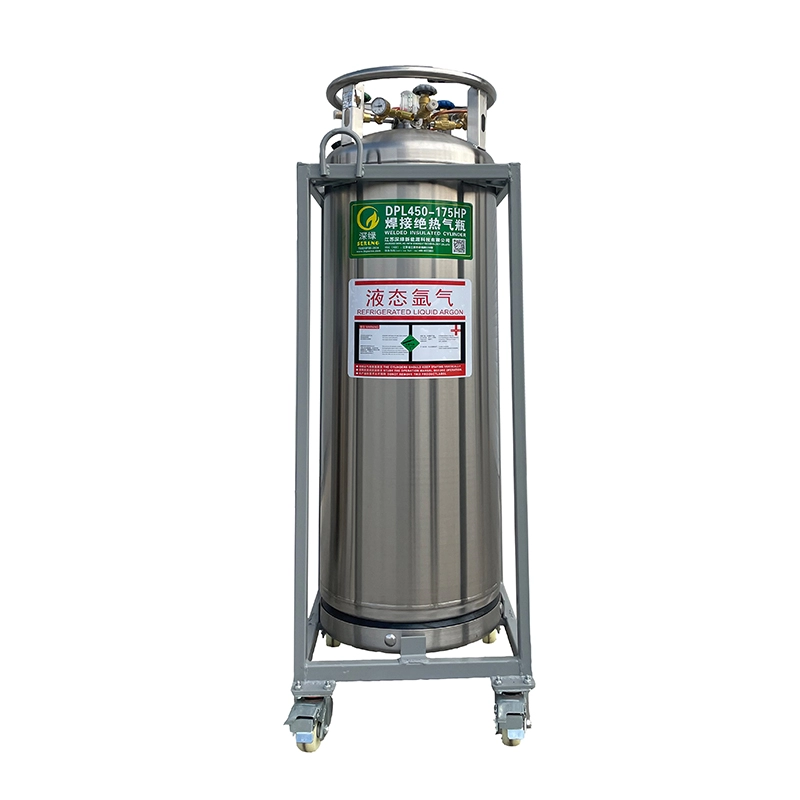
By storing and transporting the element in its cryogenic liquid state at temperatures below -185.8°C (-302.4°F), vast quantities can be managed efficiently. A single bulk liquid tank can replace hundreds of high-pressure gas cylinders, significantly reducing logistical complexities, delivery frequencies, and the labor associated with cylinder handling.
The Purity Imperative
The most critical advantage of utilizing a liquid supply system for sensitive applications is the inherent enhancement of purity.
When generating high-purity gas, the liquid source acts as a natural purifier. The process of fractional distillation used to separate air into its component gases naturally yields extremely pure liquid products. Furthermore, the continuous draw from a liquid tank through a vaporizer prevents the common contamination issues associated with exchanging gas cylinders, such as introducing atmospheric moisture or dirt during connection and disconnection.
For industries demanding High-Purity Welding, standard industrial-grade argon is often insufficient. These applications require “Ultra-High Purity” (UHP) argon, typically boasting purity levels of 99.999% (often referred to as “five nines”) or higher. The trace impurities (oxygen, moisture, total hydrocarbons) must be kept to parts per million (ppm) or even parts per billion (ppb) levels. Maintaining this level of purity from the production plant to the welding torch is substantially more manageable and reliable when utilizing a cryogenic liquid infrastructure.
Critical Applications: Where Purity is Non-Negotiable
The use of this ultra-pure, vaporized shield is not universal; it is a specialized requirement for sectors where a weld failure is catastrophic, either in terms of safety, financial loss, or product contamination.
1. Aerospace and Aviation
The aerospace industry operates on the bleeding edge of material science. Aircraft and spacecraft utilize exotic alloys—such as titanium, Inconel, and specialized aluminum grades—to maximize the strength-to-weight ratio and withstand extreme operational environments.
Titanium, in particular, is notoriously reactive. Even minute amounts of oxygen or nitrogen contamination during welding will result in embrittlement, often identifiable by a bluish or yellowish discoloration (known as “alpha case”). To successfully weld titanium components, such as engine exhaust systems or structural frames, an absolute vacuum or a perfectly pure argon purge is mandatory.
2. Semiconductor Manufacturing
The fabrication of microchips requires environments cleaner than a hospital operating room. The piping systems that deliver ultra-high purity process gases to the fabrication tools must be flawless. Any internal weld imperfection, such as a microscopic crevice or a patch of oxidation (rouge), can harbor contaminants or shed particles that will destroy the microscopic circuitry being manufactured.
In this industry, orbital welding is commonly used. This automated process relies heavily on UHP argon to purge both the outside and the inside of the tubes being joined, ensuring a perfectly smooth, unoxidized internal surface that will not compromise the semiconductor fabrication process.
3. Biopharmaceuticals and Food/Beverage
Similar to semiconductor manufacturing, the pharmaceutical and food processing industries prioritize hygiene and sterility. The stainless steel piping systems and vessels used for mixing and transporting active ingredients or food products must be easily cleanable and sterilizable.
If a weld is not perfectly smooth and free of oxidation due to inadequate shielding, it creates a microscopic haven for bacteria and biofilms to develop. These “bug traps” cannot be eliminated by standard clean-in-place (CIP) procedures, leading to severe product contamination. High-purity argon ensures that the welds maintain the same corrosion resistance and smooth surface finish as the base stainless steel material.
4. Nuclear Industry
The demands of the nuclear sector are self-evident. Components used in reactors and containment systems are subject to intense radiation, heat, and pressure over decades of service. The structural integrity of these welds must be absolute. The stringent quality assurance protocols in nuclear fabrication mandate the use of the highest quality consumables and shielding practices to prevent any potential for failure or leakage.
The Mechanics of Effective Shielding
Simply having high-purity gas available is not enough; it must be applied correctly to form an effective shield. The delivery system and the technique used are critical components of the welding process.
Flow Rate and Coverage
The flow rate of the gas is a delicate balancing act.
-
Too low: The gas will not displace the atmospheric air effectively, leading to contamination and porosity.
-
-
Too high: An excessive flow rate can cause turbulence, actually drawing ambient air into the weld zone through a Venturi effect, defeating the purpose of the shield.
-
Optimal flow rates depend on the nozzle size, the welding process, the joint design, and ambient conditions (such as drafts in the workspace). Welders use gas flow meters to precisely calibrate the delivery.
Gas Lenses
To improve coverage and reduce turbulence, specialized torch components called gas lenses are often employed, particularly in TIG welding. A gas lens contains fine layers of stainless steel mesh that act as a diffuser. Instead of a turbulent plume of gas exiting the nozzle, the gas lens produces a smooth, coherent, laminar flow. This laminar column extends further from the nozzle, providing superior protection and allowing the welder to extend the tungsten electrode further for better visibility in tight joints.
Purging: Protecting the Root
While the torch protects the top surface of the weld, the back side (or the “root”) of the joint must also be considered, especially when welding pipes or enclosed vessels. If the back of the weld is exposed to air while molten, it will oxidize severely, creating a defect known as “sugaring.”
To prevent this, the internal volume of the pipe or vessel is flooded with the inert gas before and during the welding process. This technique, known as back purging, is essential for high-purity applications. For critical stainless steel or titanium pipe welds, the internal purge gas is often monitored with an oxygen analyzer to ensure oxygen levels have dropped to acceptable ppm levels before the arc is struck.
Mixed Gases: Tailoring the Shield
While pure argon is the standard for TIG welding of non-ferrous metals and for purging, it is sometimes blended with other gases to optimize the arc characteristics for specific applications, particularly in MIG welding.
-
Argon/Helium Blends: Helium, another noble gas, has a higher ionization potential and higher thermal conductivity than argon. Adding helium to the mix increases the heat input of the arc, resulting in deeper penetration and faster travel speeds. This is often used for welding thick aluminum or copper sections.
-
Argon/CO2 Blends: For MIG welding of carbon steel, pure argon tends to produce a narrow, finger-like penetration profile and an erratic arc. Adding a small percentage of Carbon Dioxide (typically 5% to 25%) stabilizes the arc, improves the weld pool fluidity, and broadens the penetration profile.
-
Argon/Oxygen Blends: A very small addition of oxygen (1% to 2%) can be used in MIG welding of stainless steel to stabilize the arc and improve the wetting action of the weld pool without causing significant oxidation.
-
Argon/Hydrogen Blends: In highly specific TIG welding applications, such as the automated welding of austenitic stainless steel tubing, a small percentage of hydrogen (2% to 5%) can be added. Hydrogen acts as a reducing agent, helping to scavenge trace oxygen and producing exceptionally clean, bright welds with slightly increased heat input.
-
Even in these specialized blends, argon remains the foundational component, providing the primary inert shield while the additive gas fine-tunes the physical properties of the arc.
Environmental and Safety Considerations
As an inert gas, argon is not toxic, flammable, or corrosive. From an environmental standpoint, it does not contribute to smog formation or ozone depletion. It is simply borrowed from the atmosphere and eventually returns to it.
However, safety protocols must be strictly adhered to, primarily concerning asphyxiation.
The Asphyxiation Hazard
Because it is heavier than air, this gas can accumulate in low-lying areas, pits, trenches, or confined spaces (such as the inside of a large vessel being purged). It displaces oxygen. Since it is colorless and odorless, a worker entering an oxygen-deficient environment will not realize they are in danger until they become incapacitated.
Strict confined space entry procedures, continuous ventilation, and the use of personal oxygen monitors are mandatory when working with large volumes of inert gases in enclosed areas.
Cryogenic Hazards
When dealing with the liquid supply system, there are specific hazards associated with extreme cold. Contact with cryogenic liquids or uninsulated pipes can cause severe frostbite. Proper Personal Protective Equipment (PPE), including cryogenic gloves and face shields, must be worn when operating valves or connecting hoses to liquid dewars or bulk tanks.
Additionally, the massive expansion ratio mentioned earlier means that if liquid is trapped in a section of pipe between two closed valves without pressure relief devices, as it warms and vaporizes, the resulting pressure can cause catastrophic failure of the piping system.
The Future of High-Purity Fabrication
As technology advances, the materials we use become more complex, and the tolerances for failure shrink closer to zero. The demand for flawless manufacturing processes continues to rise across all high-tech sectors.
In this landscape, the role of a reliable, high-quality Shielding Gas is more critical than ever. The transition from individual high-pressure cylinders to integrated cryogenic liquid supply systems represents a maturation of manufacturing processes, prioritizing efficiency, consistency, and, above all, the unwavering purity required to meet modern engineering standards.
The invisible shield provided by Liquid Argon will continue to be a foundational element in building the future—from the microchips powering our digital world to the spacecraft exploring the cosmos, ensuring that the critical connections holding it all together remain strong, pure, and unbreakable.
FAQs
1. Can I use standard industrial argon gas instead of liquid-sourced argon for high-purity applications?
While standard industrial argon is suitable for many general fabrication tasks, it often contains trace impurities (like oxygen and moisture) that are unacceptable for high-purity applications. Sourcing from a liquid supply and utilizing vaporizers ensures a much higher baseline of purity, as the continuous draw prevents the contamination often introduced during gas cylinder changeouts. For critical industries like semiconductors or aerospace, utilizing ultra-high purity (UHP) grades sourced from bulk liquid systems is highly recommended and often mandated.
2. Why is argon preferred over nitrogen as an inert shielding environment?
While nitrogen is inexpensive and makes up 78% of the atmosphere, it is not truly inert at the extreme temperatures of a welding arc. Nitrogen can react with many metals, particularly steels and titanium, forming nitrides. These nitrides can dissolve into the weld pool, causing significant embrittlement and drastically reducing the mechanical strength of the joint. Argon, being a noble gas, remains chemically inert even at plasma temperatures, ensuring no unwanted chemical reactions occur with the molten metal.
3. What is “back purging,” and why is it necessary?
Back purging is the process of filling the internal cavity of a pipe or vessel with an inert gas (typically argon) before and during the welding process. While the welding torch protects the top surface of the joint from the atmosphere, the heat penetrates through to the inner surface (the root). If the inside of the pipe is filled with normal air, the molten root will react with oxygen, creating a rough, heavily oxidized defect known as “sugaring.” Back purging ensures both the front and back of the weld remain in a pure environment, which is essential for sanitary piping and high-stress applications.
What is Industrial Sulfur Hexafluoride?