
Unlocking the Power of Fluorine Chemistry in Semiconductor Manufacturing: A Critical Gas Analysis
The modern world runs on chips. From the smartphone in your pocket to the guidance systems in aerospace engineering, the tiny semiconductor device is the unsung hero of the digital age. But what is the hero behind the hero? It is the invisible, often volatile world of specialty gases. Specifically, fluorine chemistry plays a pivotal role in the semiconductor manufacturing process that simply cannot be replaced.
If you are managing a supply chain or overseeing product quality in a semiconductor foundry, you know that the margin for error is zero. A single spike in moisture or a microscopic particle can ruin a multimillion-dollar production run. This article dives deep into the role of fluorine-containing gases—why we use them, the specific chemistry that makes them effective, and the critical importance of supply chain stability and purity. We will explore how these high-purity gases are used in etch and deposition steps, and why sourcing them from a reliable partner is the most important decision you can make this year.
Why is the semiconductor industry so dependent on fluorine-containing gases?
To understand the semiconductor industry, you have to look at the periodic table. Silicon is the canvas, but fluorine is the brush. The semiconductor fabrication process involves building layers of materials and then selectively removing them to create circuits. This removal process is called etching.
Fluorine is the most electronegative element. In simple terms, it is incredibly hungry for electrons. When we introduce fluorine gas or fluorinated compounds into a plasma chamber, the fluorine atoms react aggressively with silicon and silicon dioxide. This chemical reaction turns solid silicon into volatile gases (like silicon tetrafluoride) that can be easily pumped away. Without this chemical reactivity, we couldn't create the microscopic trenches and contact holes required for modern electronic devices.
In high-volume manufacturing, speed and precision are everything. Fluorine-containing gases provide the high etch rates needed to keep throughput up, while also offering the selectivity to cut through one material without damaging the layer beneath it. It is a delicate balancing act of chemistry and physics.
What makes fluorine chemistry so unique for high-precision etching?
You might ask, why not use chlorine or bromine? We do, for certain layers. However, fluorine chemistry offers a unique advantage when etching silicon-based materials. The bond between silicon and fluorine is incredibly strong. When fluorine-containing plasma hits the wafer, the reaction is exothermic and spontaneous.
The magic happens in the plasma. In a semiconductor process chamber, we apply high energy to a stable gas like Carbon Tetrafluoride (CF4) or Sulfur Hexafluoride (SF6). This breaks the gas apart, releasing reactive fluorine radicals. These radicals attack the surface of the wafer.
"The precision of the etch defines the performance of the chip. If your gas purity fluctuates, your etch rate fluctuates, and your yield crashes."
This leads to the concept of anisotropic etching—cutting straight down without eating sideways. By mixing fluorine with other process gases, engineers can control the profile of the trench perfectly. This capability is essential as we move to smaller nodes (7nm, 5nm, and below), where even a nanometer of deviation is a failure.
How do gases in semiconductor manufacturing drive advanced etch processes?
Etch processes are the sculpting tools of the fabs. There are two main types: wet etch (using liquid chemicals like hydrogen fluoride) and dry etch (using plasma). Modern advanced semiconductor nodes rely almost exclusively on dry plasma etching because it is far more precise.
In a typical plasma etching sequence, a fluorinated gas is introduced. Let's look at the variety used:
- Carbon Tetrafluoride (CF4): The workhorse for oxide etching.
- Octafluorocyclobutane (C4F8): Used to deposit a polymer layer on the sidewalls of the trench, protecting them while the bottom is etched deeper.
- Sulfur Hexafluoride (SF6): Known for extremely fast silicon etching rates.
The interaction between the plasma and the substrate is complex. It involves physical bombardment by ions and chemical reaction by radicals. The semiconductor manufacturing equipment must strictly control the flow, pressure, and mixture of these gases. If the specialty gas contains impurities like moisture, it can form hydrofluoric acid within the delivery lines or the chamber, causing corrosion and particle defects.

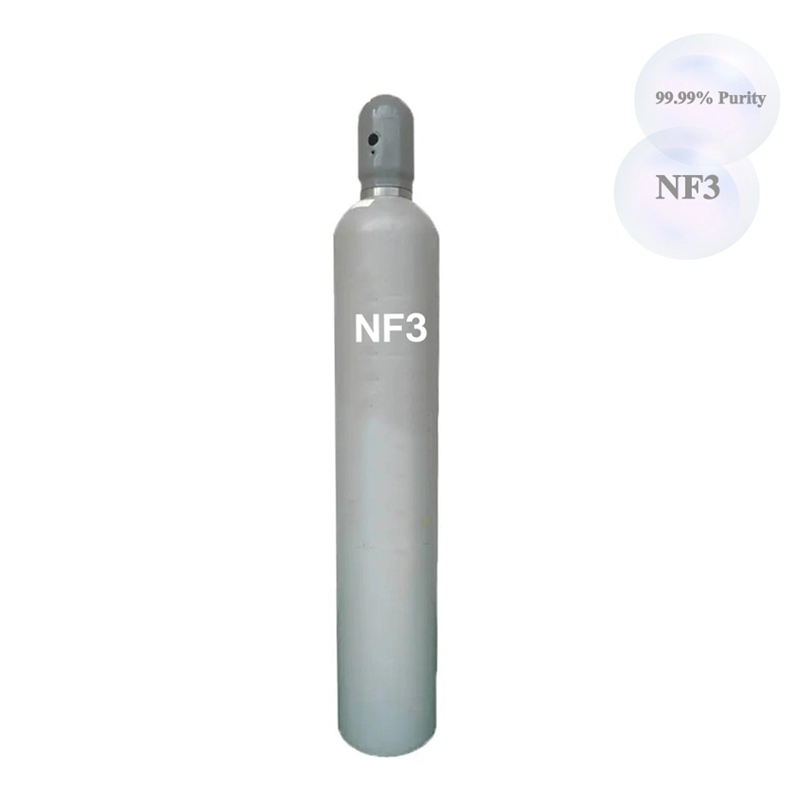
Why is Nitrogen Trifluoride the king of chamber cleaning applications?
While etching and cleaning go hand in hand, cleaning the manufacturing equipment is just as vital as processing the wafer. During Chemical Vapor Deposition (CVD), materials like silicon or tungsten are deposited onto the wafer. However, these materials also coat the walls of the chamber. If this residue builds up, it flakes off and falls onto the wafers, causing defects.
Enter Nitrogen Trifluoride (NF3).
Years ago, the industry used fluorinated greenhouse gases like C2F6 for chamber cleaning. However, NF3 has become the standard for chamber cleaning processes because of its high efficiency. When broken down in a remote plasma source, NF3 generates a massive amount of fluorine atoms. These atoms scrub the chamber walls clean, turning solid residues into gas that is pumped out.
Nitrogen Trifluoride is preferred because it has a higher utilization rate (more of the gas is actually used) and lower emissions compared to older cleaning agents. For a facility manager, this means less downtime for maintenance and faster throughput.
Which fluorinated compounds are essential for high-volume manufacturing?
The semiconductor supply chain relies on a basket of specific fluorine-containing gases. Each has a specific "recipe" or application. At Jiangsu Huazhong Gas, we see a massive demand for the following:
| Gas Name | Formula | Primary Application | Key Feature |
|---|---|---|---|
| Carbon Tetrafluoride | CF4 | Oxide Etch | Versatile, industry standard. |
| Sulfur Hexafluoride | SF6 | Silicon Etch | High etch rate, high density. |
| Nitrogen Trifluoride | NF3 | Chamber Cleaning | High efficiency, lower emission. |
| Octafluorocyclobutane | C4F8 | Dielectric Etch | Polymerizing gas for sidewall protection. |
| Hexafluoroethane | C2F6 | Oxide Etch / Clean | Legacy gas, still widely used. |
These fluorinated compounds are the lifeblood of high-volume manufacturing. Without a steady stream of these gases in semiconductor production, the lines stop. It is that simple. This is why purchasing managers like Eric Miller are constantly monitoring the supply chain for disruptions.
Why are high-purity gases the backbone of semiconductor yield?
I cannot stress this enough: Purity is everything.
When we talk about high-purity gases, we aren't talking about "industrial grade" used for welding. We are talking about 5N (99.999%) or 6N (99.9999%) purity.
Why? Because a semiconductor device has features measured in nanometers. A single molecule of a metal impurity or a trace amount of moisture (H2O) can cause a short circuit or prevent a layer from adhering.
- Moisture: Reacts with fluorine to create HF, which corrodes the gas delivery system.
- Oxygen: Oxidizes the silicon uncontrollably.
- Heavy Metals: Destroy the electrical properties of the transistor.
As a supplier, our job is to ensure that the high-purity Xenon or Electronic Grade Nitrous Oxide you receive meets strict industry standards. We use advanced gas chromatography to detect trace impurities down to parts per billion (ppb). For a buyer, seeing the Certificate of Analysis (COA) isn't just paperwork; it is the guarantee that their semiconductor fabrication won't face a catastrophic yield crash.

How is the industry managing greenhouse gas emissions and GWP?
There is an elephant in the room: the environment. Many fluorinated gases have a high Global Warming Potential (GWP). For example, Sulfur Hexafluoride (SF6) is one of the most potent greenhouse gases known to man, with a GWP thousands of times higher than CO2.
The semiconductor manufacturing industry is under immense pressure to reduce its carbon footprint. This has led to two major shifts:
- Abatement: Fabs are installing massive "burn boxes" or scrubbers on their exhaust lines. These systems break down the unreacted greenhouse gas before it is released into the atmosphere.
- Substitution: Researchers are looking for alternative etch gases with lower GWP. However, finding a molecule that performs as well as C4F8 or SF6 without the environmental impact is chemically difficult.
Nitrogen Trifluoride was a step in the right direction for cleaning because it breaks down more easily than older PFCs, resulting in less overall emission if abatement systems are working correctly. Reducing greenhouse gas emissions is no longer just a PR move; it is a regulatory requirement in the EU and US.
Is the semiconductor supply chain vulnerable to specialty gas shortages?
If the last few years have taught us anything, it is that the supply chain is fragile. Semiconductor manufacturers have faced shortages of everything from neon to fluoropolymers.
The supply of fluorine gas and its derivatives depends on the mining of fluorspar (calcium fluoride). China is a major global source of this raw material. When geopolitical tensions rise or logistics routes clog up, the availability of these critical process gases drops, and prices skyrocket.
For a buyer like Eric, the fear of "Force Majeure" is real. To mitigate this, savvy companies are diversifying their suppliers. They are looking for partners who own their own iso-tanks and have established logistics networks. Reliability in logistics is just as important as the purity of the gas. You can have the purest C4F8 gas in the world, but if it is stuck at a port, it is useless to the fab.
What are the safety protocols for handling Hydrogen Fluoride and other toxic materials?
Safety is the bedrock of our industry. Many fluorine-containing gases are either toxic, asphyxiants, or highly reactive. Hydrogen Fluoride (HF), often used in wet etch or generated as a byproduct, is particularly dangerous. It penetrates the skin and attacks the bone structure.
Handling these materials requires rigorous training and specialized equipment.
- Cylinders: Must be DOT/ISO certified and regularly inspected for internal corrosion.
- Valves: Diaphragm valves are used to prevent leakage.
- Sensors: Semiconductor fabs are covered in gas detection sensors that trigger alarms at the slightest leak.
When we fill a cylinder with Electronic Grade Nitrous Oxide or a toxic etchant, we treat it like a loaded weapon. We ensure the cylinder is polished internally to prevent particulates and that the valve is capped and sealed. For our customers, knowing that the carrier gas or etchant arrives in safe, compliant packaging is a major relief.

What lies ahead for materials used in the semiconductor fabrication process?
The semiconductor production roadmap is aggressive. As chips move to 3D structures like Gate-All-Around (GAA) transistors, the complexity of etching and cleaning increases. We are seeing a demand for more exotic fluorinated gas mixtures that can etch deep, narrow holes with atomic precision.
Atomic Layer Etching (ALE) is an emerging technique that removes material one atomic layer at a time. This requires incredibly precise dosing of reactive gases. Furthermore, the push for "green" manufacturing will likely drive the adoption of new fluorine chemistry that offers the same performance with lower GWP.
The future belongs to those who can innovate in both gas synthesis and purification. As semiconductor materials evolve, the gases used to shape them must evolve too.

Key Takeaways
- Fluorine is Essential: Fluorine chemistry is the key enabler for etch and clean steps in semiconductor manufacturing.
- Purity is King: High-purity (6N) is non-negotiable to prevent defects and ensure process stability.
- Variety of Gases: Different gases like CF4, SF6, and Nitrogen Trifluoride serve specific roles in fabrication.
- Environmental Impact: Managing greenhouse gas emissions and abatement is a critical industry challenge.
- Supply Security: A robust supply chain and reliable partners are necessary to avoid production stoppages.
At Jiangsu Huazhong Gas, we understand these challenges because we live them every day. Whether you need High Purity Xenon for your newest etch process or reliable delivery of standard industrial gases, we are here to support the technology that builds the future.